
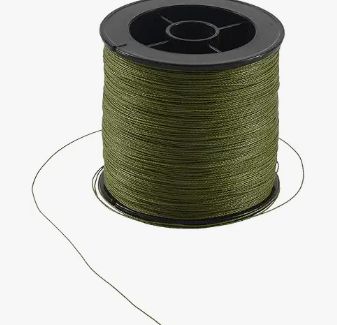
Description
Clive Branson’s Fishing Tackle Recommendations – Braided Fishing Line
Throughout my international match fishing career, I’ve always believed that choosing the correct fishing line is one of the most important decisions an angler can make.
Your line is the vital connection between you and the fish.
Modern braided fishing lines have introduced some interesting possibilities, particularly for anglers who enjoy feeder fishing at distance.
However, like most fishing tackle, braided line has advantages and disadvantages, and understanding when to use it is far more important than simply buying the most expensive product.
What is braided fishing line?
Unlike traditional monofilament, which is usually manufactured as a single strand of nylon or another polymer, braided fishing line is made from multiple fibres woven together.
This produces a line with very little stretch and a high breaking strain relative to its diameter.
These characteristics can make braided line particularly effective for certain types of fishing.
The advantage of low stretch
One of the biggest differences between braided line and monofilament is the amount of stretch.
Monofilament has a degree of elasticity, which can help absorb sudden movements from a hooked fish.
Braided line has very little stretch, allowing movements at the terminal tackle to be transmitted more directly to the rod tip.
This can be particularly useful when feeder fishing at longer distances, where detecting delicate bites can sometimes be difficult.
Braided line for feeder fishing
For some feeder fishing situations, braided line can offer excellent sensitivity and bite detection.
When fishing at distance, the low stretch allows the angler to see small movements more clearly.
However, I would always recommend checking that your rod, reel and terminal tackle are suitable for braided line.
When casting heavier feeders, an appropriately rated shock leader may be necessary to withstand the forces involved.
Is braid suitable for float fishing?
For most of my traditional float fishing, particularly with stick floats and wagglers, monofilament remains a very practical choice.
Its suppleness, controlled stretch and handling characteristics make it well suited to many float fishing methods.
Braided line can sometimes create difficulties when fishing with very light hooklengths because there is less elasticity to cushion sudden movements.
For this reason, I wouldn’t automatically recommend braid as the first choice for a beginner learning traditional float fishing.
Choosing the correct diameter
One of the attractions of braided line is its relatively fine diameter for a given breaking strain.
However, braid diameters and breaking strain ratings can vary between manufacturers.
I recommend choosing a reputable brand and selecting a line appropriate for the method, casting weight and fish you’re targeting.
Don’t assume that the highest breaking strain is automatically the best choice.
Abrasion resistance and line care
Although braided line can be extremely strong for its diameter, some braids are vulnerable to damage when rubbed against sharp rocks, mussels or other abrasive surfaces.
Regularly inspect the line for fraying and replace any damaged sections.
Pay particular attention to knots, connections and areas that have been subjected to heavy wear.
Also remember that braid can cut into skin under tension, so never wrap it around your fingers when pulling against a snag.
Playing fish on braided line
Because braid has very little stretch, it’s important to use your rod and reel clutch correctly.
A smoothly adjusted clutch and a suitable rod action can help absorb sudden lunges from a hooked fish.
I would also recommend taking particular care when using fine hooklengths, especially when fishing for larger or powerful species.
My advice
Braided fishing line can be an excellent choice for certain methods, particularly feeder fishing where sensitivity is important.
However, it isn’t a universal replacement for monofilament.
Choose your line according to the method you’re using, the distance you’re fishing and the type of fish you’re targeting.
Above all, remember that good presentation, sensible tackle selection and understanding fish behaviour are far more important than simply using the latest equipment.
As an Amazon Associate, I earn from qualifying purchases.


Reviews
There are no reviews yet.